

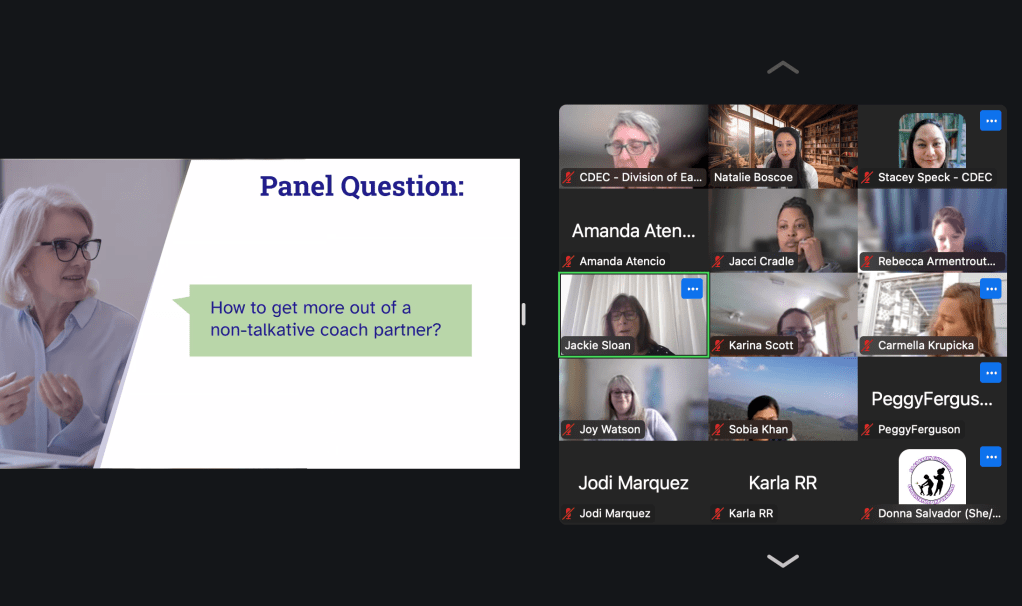
I was recently asked to be on an expert coaches panel hosted by the Colorado Department of Early Childhood Education.These monthly meetings bring early childhood coaches from across the state of Colorado together to learn from and with one another. I was honored to be asked to share my expertise and experience as a coach. One of the questions I spoke about was how to get non-talkative coaching partners to share more. This question often comes up a lot for education coaches, especially in early childhood. Sometimes education coaches enter into a coaching partnership in which the partner is reluctant or unsure about the coaching process. In these cases, school directors might request the coaches support and the teacher has little to no say in the matter.
My first piece of advice is to build a relationship with the coaching partner. This is foundational and the key to success. Education coaches often want to rush in to solve a problem and see immediate change, but coaches should slow down and ask authentic relationship building questions. Some of my go-to questions are:
What first interested you in a career in early childhood education? What is the most exciting thing about the age you work with? What is something that is challenging about the age you work with? What do you like to do when you are not working? I’d love to hear about a time where you felt really successful.
These questions help you get to know your coaching partner and hopefully get your coaching partner talking about something they enjoy.
The second piece of advice is to reflect on whether you are creating an environment to support your coaching partner to feel comfortable to share. This means reflecting on the physical environment, your body language and the “space” you are creating. The “space” can include emotional and mental space as well as you embracing the silent pause. It is so important to offer your coaching partner time to think, process and respond after you ask a question or invite a response. The next time you ask a question, try counting to 10 before you speak again. Become comfortable in the silence.
These are just a few tips I use to get more out of a quiet coaching partner. Would love to hear your tips and strategies!
 Natalie Drucker Boscoe
You must be logged in to post a comment.